
Few skin treatments carry as much promise — or as much confusion — as laser skin resurfacing. The name covers a whole family of devices, from gentle “lunchtime” lasers that leave barely a mark to powerful ablative systems that genuinely resurface the skin and demand real recovery time. Understanding where a treatment sits on that spectrum is often the difference between a result you are delighted with and a surprise you were not prepared for. This guide explains what laser resurfacing actually does, what it can realistically treat, who it suits — and the part clinics sometimes gloss over: what the recovery really looks like.
What is laser skin resurfacing?
Laser skin resurfacing uses tightly focused beams of light to improve both the surface and the deeper structure of the skin. In simple terms, the laser delivers energy that is absorbed by a target in the skin — usually water, sometimes pigment — heating tiny, precisely controlled zones of tissue. Depending on the wavelength and intensity, this either removes the outer layers of skin so that fresher skin grows in their place, or heats the deeper dermis to stimulate new collagen without breaking the surface.
Both routes aim at the same destination: smoother texture, more even tone, and firmer, fresher-looking skin. The key thing to grasp is that “laser resurfacing” is an umbrella term, not a single machine or a single experience. Two people can both have “laser resurfacing” and go through completely different treatments and recoveries.
Ablative vs non-ablative: the key difference
The most important distinction to understand — and the one that shapes your downtime, your results and your risk — is between ablative and non-ablative lasers.
Ablative lasers (such as CO2 and erbium/Er:YAG systems) remove the outermost layers of skin while heating the tissue beneath. By effectively taking off damaged skin and prompting a wave of new collagen, they tend to produce the most noticeable results, often in fewer sessions. The trade-off is real downtime while the treated skin heals.
Non-ablative lasers leave the surface of the skin intact and instead heat the deeper dermis to encourage collagen renewal from within. They are gentler, with far less downtime, but the results are subtler and build gradually, usually over a course of sessions.
| Feature | Ablative laser | Non-ablative laser |
|---|---|---|
| How it works | Removes outer skin layers and heats below | Heats deeper skin; surface left intact |
| Strength of result | More noticeable, often fewer sessions | Subtler, builds over a course |
| Typical downtime | Around one to two weeks of visible healing | Little to none; perhaps a day of redness |
| Sessions needed | Often one, sometimes a small course | Usually a course of several |
| Best suited to | Deeper lines, sun damage, scarring, marked texture | Early lines, dullness, mild texture, maintenance |
| Relative risk | Higher (pigment change, infection, scarring) | Lower, though never zero |
Where “fractional” fits in
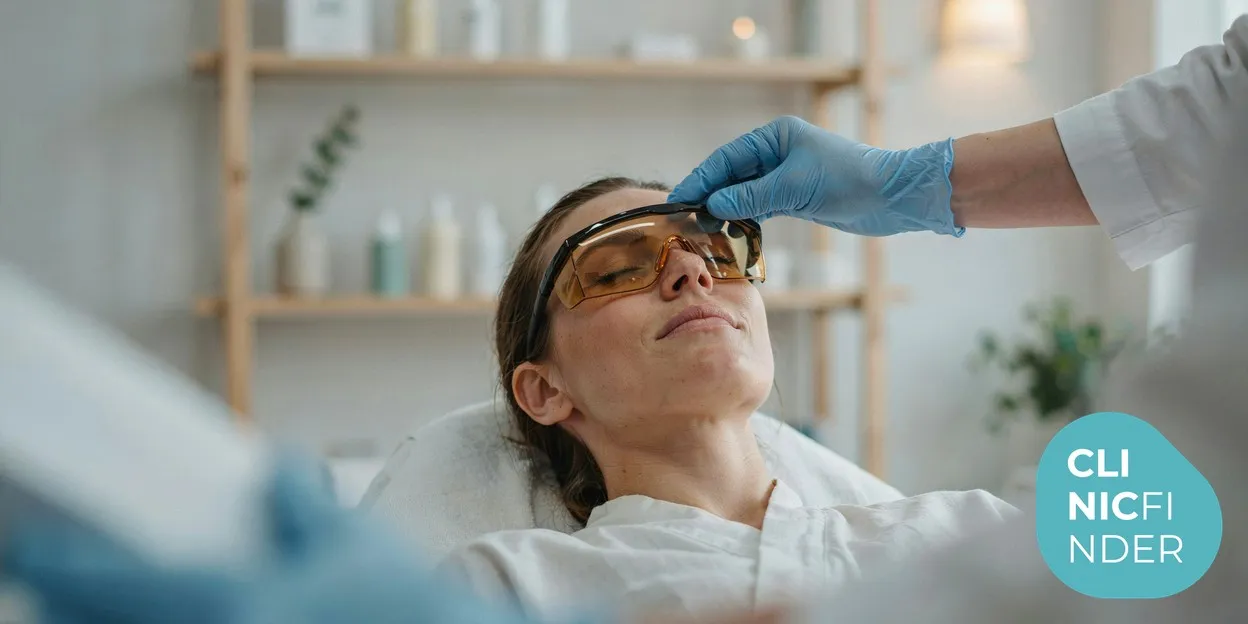
You will also hear the word fractional. A fractional laser treats only a fraction of the skin at a time, creating a grid of microscopic treatment columns and leaving healthy skin in between. That untouched skin acts as a reservoir for healing, which speeds recovery and lowers risk compared with treating the whole surface at once. Both ablative and non-ablative lasers can be delivered in a fractional pattern. Fully ablative, full-field resurfacing — treating the entire surface — can be powerful but is used more selectively now, because it carries longer recovery and higher risk. Fractional approaches have become the more common middle ground.
What laser resurfacing can help with
Used appropriately, laser resurfacing can improve a range of concerns:
- Fine lines and wrinkles, particularly the finer lines around the eyes and mouth
- Uneven texture and roughness, giving a smoother, more refined surface
- Sun damage and some pigmentation, such as age spots and general dullness from years of UV exposure
- Certain scars, including some acne scarring and other textural scars
- Overall radiance and firmness, as new collagen remodels over the following months
It is important to be honest about the limits, too. Laser resurfacing is not a substitute for surgery when there is significant skin laxity or heavy sagging — energy-based tightening can only do so much. Some pigmentation conditions, such as melasma, can be unpredictable and may even worsen with the wrong laser, so they need careful, specialist handling. And it will not halt the ageing process itself.
The honest headline: a good laser can genuinely refine and renew skin, but it cannot stop it ageing. Sun protection is what preserves the result.
Who is — and isn’t — a good candidate
The best candidates are people with realistic expectations who understand they may need a course, and who are willing to protect their skin from the sun afterwards. A thorough consultation should assess your skin type, your concerns and your medical history before anything is booked.
Laser resurfacing is usually avoided or approached with extra caution in several situations: during pregnancy or breastfeeding; where there is an active skin infection in the area (a tendency to cold sores often means antiviral cover is arranged first, as lasers can trigger a flare); soon after a course of oral isotretinoin (many clinics wait a period before treating); and in people prone to keloid or other abnormal scarring.
Skin tone matters. Richer, darker skin tones can be treated successfully, but some wavelengths and higher energies carry a greater risk of post-treatment pigment changes. This is precisely why device choice, appropriate settings, a patch test and an experienced practitioner are non-negotiable. If a clinic cannot explain how they will adapt the treatment to your skin type, that is a reason to look elsewhere.
What the recovery really looks like
This is the part worth reading twice, because it is where expectations most often go wrong.
After a non-ablative or light fractional treatment, recovery is usually mild. Expect redness and a warm, tight feeling — a bit like mild sunburn or windburn — that typically settles within a day or two. Some people have slight swelling or a rough, sandpapery texture for a few days as the skin renews. Many can wear mineral makeup and return to work quickly.
After ablative resurfacing, recovery is a genuine process, not an afterthought. Broadly, the first few days involve redness, swelling and skin that may weep or ooze as it begins to heal; this is normal and is managed with gentle cleansing, ointments and cool compresses as your clinic directs. Over roughly the following week the skin tends to crust, flake and peel while new, pink skin emerges beneath. By around one to two weeks the surface has usually healed enough to cover with makeup, though a pink or red tone can linger and fade gradually over several weeks — occasionally months for deeper treatments. Underneath all of this, collagen continues to remodel for months, which is why the final result is not the same as how the skin looks the day the peeling stops.

Throughout recovery, two things matter enormously: keeping the skin protected from the sun and following the aftercare to the letter. Diligent broad-spectrum SPF is not optional — freshly resurfaced skin is highly vulnerable to pigment problems if exposed to UV. A good clinic will give you clear written aftercare and a point of contact if you are worried about anything.
Risks, and how a good clinic reduces them
For most people, side effects are temporary: redness, swelling, itching, and dryness or peeling as the skin heals. The risks that deserve real attention are:
- Infection, including bacterial infection and reactivation of cold-sore (herpes) virus, which is why prophylactic antivirals are often prescribed.
- Pigment changes — skin that heals darker (post-inflammatory hyperpigmentation) or, less commonly, lighter than surrounding skin. This is more likely in darker skin tones and with sun exposure during healing.
- Scarring, which is rare but more likely with overly aggressive settings, treatment of the wrong candidate, or poor aftercare.
- Prolonged redness or small white bumps (milia) during healing.
- Underwhelming results, especially if the wrong laser or too gentle a plan is used for the concern.
Almost every one of these risks is reduced by the same things: proper assessment and skin typing, a patch test where appropriate, a careful medical history, honest expectation-setting, an appropriate device, a trained practitioner, a properly regulated clinic, and structured aftercare with follow-up. In other words, the clinic and practitioner you choose influence your outcome at least as much as the machine does.
What it tends to cost
Prices vary widely and are difficult to generalise, because they depend on the device, whether the treatment is ablative or non-ablative, the size of the area, and how many sessions you need. As a rough guide, a single non-ablative or light fractional session often costs a few hundred pounds, while full-face ablative resurfacing can run into four figures for a course or a deeper treatment. When comparing quotes, ask what is included — consultation, patch test, aftercare products and review appointments all add value — and remember that the cheapest option is rarely the safest way to choose a treatment that involves heating and healing your skin.
Making an informed choice
Laser skin resurfacing can be one of the more transformative non-surgical skin treatments — but only when the type of laser is matched to your skin and your concern, and only when you go in with a clear picture of the recovery. It is a considered decision, not an impulse buy. If you are weighing your options, it is worth understanding how lasers compare with IPL, how chemical peels offer a different route to resurfacing, and how gentler microneedling and collagen induction can suit those wanting less downtime.
Above all, the clinic and practitioner matter more than any single device. Use Clinic Finder to compare accredited clinics near you, check your practitioner’s training and experience with your skin type, and ask directly about the exact laser they use, the downtime to expect and how they manage risks like pigment change. Our guide to choosing an aesthetic clinic walks you through the questions worth asking before you book.
