Focused ultrasound can destroy mapped tissue in hospital medicine or create smaller thermal zones in aesthetics, but those uses share physics rather than one evidence base. Evidence is indication- and device-specific, with selected facial uses better studied than intimate cosmetic HIFU.
Evidence reviewed •UK-focused•No clinic controls this guide
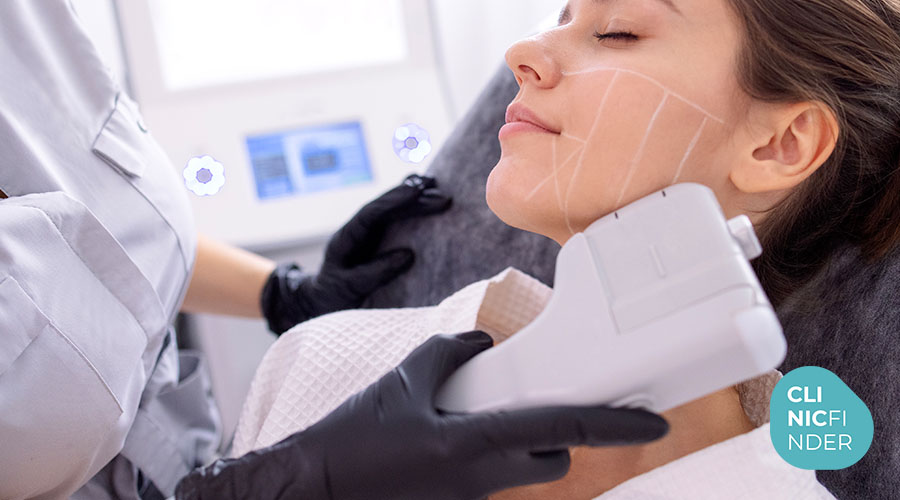
This image shows aesthetic facial HIFU. Hospital HIFU and intimate HIFU are different procedures with different targets and evidence.
Medical HIFU
Ablates selected tissue
Aesthetic HIFU/MFU
Aims to remodel collagen
Intimate HIFU
Separate, sparse evidence
Guidance
Depends on the indication
Aesthetic result
Usually subtle and gradual
Key rule
Do not transfer evidence between uses
Start here
What it is — without the sales pitch
Focused ultrasound concentrates acoustic energy at depth without an incision. At sufficiently high intensity it can heat and destroy a deliberately selected tissue target. In hospital medicine this may be planned with MRI or ultrasound imaging, temperature monitoring, anaesthesia and multidisciplinary governance—for example in selected prostate, uterine-fibroid or movement-disorder procedures.
Aesthetic HIFU or microfocused ultrasound uses device-specific focal depths and treatment lines to create small thermal injury zones beneath the skin. The aim is collagen remodelling and a modest change in mild laxity, not tumour ablation and not a surgical facelift.
Intimate HIFU is a third proposition. Devices are marketed for “tightening”, urinary symptoms or sexual concerns, but direct high-quality evidence is sparse. Medical studies of HIFU for vaginal intraepithelial neoplasia or vulval disease do not demonstrate that cosmetic vaginal HIFU works.
Our bottom line
HIFU is a genuine medical technology, but “used in hospitals” is not proof for a salon device or cosmetic claim. Judge the exact device, intended tissue, operator, indication and evidence separately.
What it may help with
Mild-to-moderate laxity around the brow, lower face, jawline or neck
Someone who accepts a subtle and variable change rather than surgery
A specific medical condition when a specialist multidisciplinary service recommends an evidence-governed focused-ultrasound procedure
What it will not do
Remove a large amount of loose skin or reproduce a surgical facelift
Reliably treat every wrinkle, pigment change or volume loss
Make hospital use proof that an aesthetic or intimate device is effective
For facial treatment, the exact device, cartridge depth, mapping and operator technique influence both outcome and risk.
One technology family, different clinical questions
Medical, aesthetic and intimate HIFU are not interchangeable
All focus ultrasound energy, but they differ in target, dose, imaging, monitoring, governance and the outcome being measured.
01
Tissue ablation in specialist care
Image-guided medical HIFU / focused ultrasound
Destroy a mapped disease target such as selected prostate or fibroid tissue, or create a controlled brain lesion for a specific tremor indication.
What the evidence tells us
This field shows that focused ultrasound can produce precise biological effects without an incision. NICE still applies indication-specific limits: focal prostate HIFU requires special governance because efficacy evidence is limited; focused ultrasound for Parkinsonian tremor is research-only.
Keep in view
Hospital delivery can involve MRI or ultrasound targeting, anaesthesia, thermal monitoring and a multidisciplinary team. It is not the same procedure as cosmetic facial HIFU.
02
Non-surgical skin lifting and tightening
Aesthetic facial HIFU / MFU-V
Create small thermal zones at planned depths to stimulate remodelling in mildly or moderately lax tissue.
What the evidence tells us
A 2025 review supports some improvement and satisfaction, particularly for microfocused ultrasound with visualisation, but scoring methods can inflate apparent benefit and pain was moderate on average.
Keep in view
Results are usually subtle. Device, cartridge, depth and mapping matter; burns, nerve symptoms and unwanted fat loss can occur.
03
Vaginal or vulval energy treatment
Intimate HIFU
Marketed for laxity, sexual function or urinary symptoms through collagen remodelling.
What the evidence tells us
Direct controlled evidence for cosmetic intimate HIFU is sparse. A small retrospective study of female incontinence cannot establish effectiveness, durability or comparative benefit.
Keep in view
Disease-treatment studies involving vaginal or vulval lesions answer a different question. Symptoms need gynaecological or pelvic-floor assessment before any cosmetic energy treatment.
Results & trade-offs
What to realistically expect
01
Start with the indication
Prostate ablation, fibroid treatment, tremor thalamotomy, facial tightening and intimate treatment have different targets and outcomes. Ask which evidence applies to yours.
02
Aesthetic improvement is usually subtle
Recent pooled studies report facial improvement and satisfaction, but permissive scoring may overestimate how many people see a meaningful change.
03
Pain is not always minimal
A 2025 review reported a pooled mean pain score of 4.85 out of 10, with wide variation between studies.
04
Monitoring changes the context
Medical procedures may use real-time imaging, thermal mapping and hospital governance. Aesthetic “visualisation” can help identify tissue layers but does not turn a cosmetic treatment into medical ablation.
R
Research in context
What research can — and cannot — tell us
Medical HIFU evidence varies by disease and remains governed accordingly. Aesthetic reviews support a modest effect for selected facial devices. Direct evidence for intimate cosmetic HIFU is much thinner.
For aesthetic MFU-V, the 2025 meta-analysis included 42 studies but still called for better trials; satisfaction fell from 84% to 62% where a neutral answer was allowed. Medical guidance is also not uniformly positive: NICE considers focal prostate HIFU safety adequate but efficacy limited, while Parkinsonian tremor use remains research-only.
Safety
Risks should be part of the decision
“Non-surgical” does not mean risk-free. The exact device or product, treatment area, practitioner and your health all change the risk.
01
Common or expected
Pain or sharp sensations during treatment
Temporary redness, swelling, tenderness or bruising
Tingling or short-lived altered sensation
02
Important complications
Burns, welts or prolonged pain
Temporary or persistent nerve injury, weakness or altered sensation
Unwanted fat loss, hollowing, contour change or scarring when energy reaches an unsuitable plane
03
Get prompt medical advice
Blistering, skin breakdown or severe escalating pain
New facial weakness, an uneven smile or persistent numbness
A marked hollow, lump or contour change that develops after treatment
If you feel seriously unwell or have trouble breathing, seek urgent medical help. This page cannot assess an individual complication.
Suitability
A consultation should sometimes end with “no”
It may be reasonable to explore if…
Your concern is mild-to-moderate laxity and expectations are conservative
The practitioner can explain why the device and treatment depths suit your anatomy
You understand other causes such as volume loss may need a different approach
Pause and get individual advice if…
Very thin tissue, little facial fat or concern about hollowing
Active skin disease, infection, impaired sensation or open wounds
Implants, previous surgery, fillers or threads in the area without appropriate clinical assessment
The treatment journey
What good care should look like
01
Define the clinical or cosmetic problem
A medical disease, facial laxity and intimate symptom require different diagnostic pathways. Do not begin with “I want HIFU” before the problem is properly named.
02
Match evidence to the exact device and use
Record manufacturer, model, intended use, target depth, imaging or visualisation and the evidence for that indication—not HIFU in general.
03
Plan delivery and safeguards
Medical ablation belongs in specialist governance. Aesthetic treatment needs anatomical mapping and complication planning. Intimate symptoms need appropriate clinical assessment first.
04
Measure the relevant outcome
Cancer control, fibroid symptoms, tremor, facial laxity and urinary or sexual symptoms require different validated outcomes and follow-up periods.
Aesthetic HIFU usually aims for a subtle remodelling effect rather than a surgical-facelift result.Careful assessment and treatment mapping matter; evidence for one face or neck protocol cannot be transferred automatically to another body area.
Compare your options
The alternative is not always another procedure
No treatment or skincare
Skincare can improve surface quality but will not lift substantial laxity; no procedure avoids energy-device risk.
Radiofrequency
Another heat-based category with device-specific evidence and risks; it is not automatically gentler or better.
Injectables
May address volume or muscle movement rather than laxity, with different risks and maintenance.
Surgery
Can create a larger and more predictable lift, with anaesthetic, scars, recovery and surgical risk.
Take this to your consultation
Questions worth asking before you pay
01
What is the exact device and intended use, and does it provide visualisation?
02
Is the evidence you are quoting for this exact medical, facial, body or intimate indication?
03
Is my concern skin laxity, volume loss, fat, muscle movement or a mixture?
04
What change is realistic without using the word “facelift”?
05
Which depths and areas will you treat or avoid, and why?
06
How do you reduce the risk of nerve injury, burns and unwanted fat loss?
07
When will we assess the final result, and who manages a complication?
Source library
Research and guidance behind this page
We link to guidance and papers so you can check the evidence yourself. A source appearing here does not mean every claim or conclusion in it is beyond debate.
Current policy context for England; HIFU was included in proposed medium-risk procedures during consultation.
Common questions
Frequently asked questions
Is medical HIFU the same as cosmetic HIFU?
No. Both focus ultrasound, but medical ablation treats a mapped disease target under condition-specific specialist governance. Cosmetic HIFU uses different devices and protocols to seek a modest aesthetic change. Medical use does not validate a cosmetic claim.
What is HIFU used for in medicine?
Focused ultrasound has been assessed for selected uses including focal prostate treatment, uterine fibroid ablation and MRI-guided thalamotomy for tremor. Evidence and NICE recommendations differ for each use; it is not a blanket standard treatment for every condition.
Is HIFU really a non-surgical facelift?
No. That phrase overstates the likely effect. Selected patients may see a subtle lift or tightening, but HIFU cannot remove loose skin or reproduce surgical repositioning.
Does HIFU hurt?
It can. Sensation depends on device, energy, site and the person. A 2025 review found moderate average pain with substantial variation.
Can HIFU cause facial fat loss?
Unwanted fat or contour change is a recognised concern when energy reaches an unsuitable depth or a person has little tissue reserve. Discuss facial thinness and treatment planes explicitly.
Are all HIFU devices equivalent?
No. They differ in energy delivery, depths, visualisation, evidence and intended use. Ask for the manufacturer and model, not just the technology name.
Does research on HIFU for vaginal disease prove intimate tightening works?
No. Treating a diagnosed lesion such as vaginal intraepithelial neoplasia has a different target, protocol and outcome from treating laxity, urinary symptoms or sexual concerns.
Clinic directory
Compare clinics offering HIFU
Directory information is separate from our editorial assessment. Inclusion is not a medical endorsement.