
Many women reach their mid-forties or fifties feeling their skin has changed almost overnight. It looks drier, feels less firm, seems to have lost its bounce, and stubborn breakouts or new patches of pigmentation appear where there were none before. If that sounds familiar, you are not imagining it — and it is not simply a matter of “getting older”. The menopause brings a distinct shift in skin biology, driven mainly by falling oestrogen, and understanding what is happening makes it far easier to choose what genuinely helps. This guide explains the changes and the options that can support your skin through the transition, from everyday skincare to clinic treatments.
Why menopause changes your skin
The central player is oestrogen. Throughout your adult life this hormone helps keep skin thick, hydrated and elastic. It supports the fibroblasts that manufacture collagen and elastin, encourages the skin to hold onto water, and helps maintain the natural oils that keep the barrier comfortable and resilient. As oestrogen declines through the perimenopause and after your final period, that support is gradually withdrawn — and the skin’s structure and behaviour change with it.
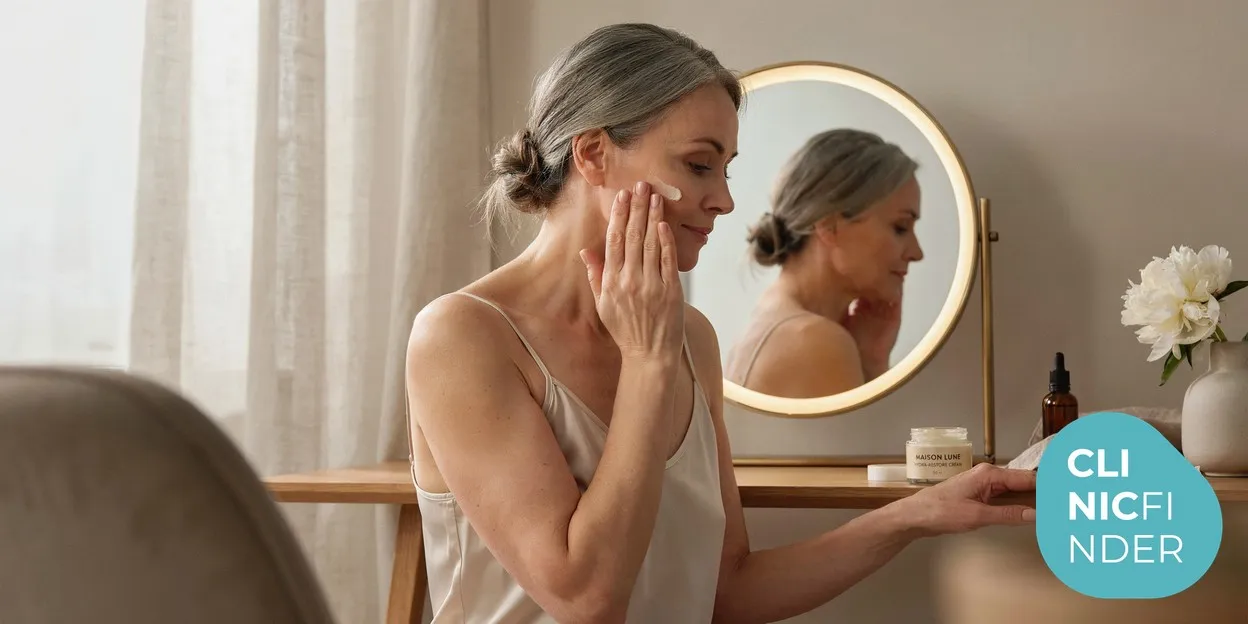
The effect is not subtle. Collagen — the protein scaffold that gives skin its firmness — declines noticeably in the years around menopause. Research often quoted in this field suggests women may lose a considerable share of their skin’s collagen, commonly put at up to around a third, in roughly the first five years after their final period, followed by a slower, steadier decline in the years after. Because collagen and elastin give skin its strength and spring, this is what lies behind the thinning, softening and increased laxity so many women notice. At the same time, falling oestrogen accelerates changes deeper down — in the facial fat pads and even the underlying bone — which subtly alters facial contour and support, independent of the skin’s surface quality.
The skin changes you may notice
Everyone experiences this differently, but a handful of changes come up again and again.
Dryness, sensitivity and a weaker barrier
Oestrogen helps skin produce oil and retain moisture, so its decline commonly leaves skin drier, tighter and sometimes itchy — a symptom many women find genuinely uncomfortable. The skin barrier can become more fragile and reactive, so products that never troubled you before may suddenly sting, and skin can look duller as cell turnover slows.
Loss of firmness and fine lines
With less collagen and elastin, skin becomes thinner and less resilient. Fine lines deepen, the jawline softens, and mild sagging around the cheeks and jowls becomes more noticeable. Volume loss from shifting facial fat pads adds to the overall change in facial shape, which is why the effect can feel structural rather than just skin-deep.
Breakouts and unwanted hair
As oestrogen falls, the relative influence of androgens rises. For some women this triggers adult, hormonal breakouts — often along the jawline and chin — and, for others, a few coarser hairs on the chin or upper lip. Facing teenage-style spots and menopausal dryness at the same time can feel particularly unfair, but both stem from the same underlying hormonal shift.
Pigmentation and redness
Years of accumulated sun exposure often surface now as age spots and uneven tone. Many women also notice more flushing, redness or rosacea-type reactivity, sometimes linked to hot flushes, which can leave the skin looking blotchier than before.
No cream or clinic treatment can switch oestrogen back on. The realistic goal is to support your skin’s quality and comfort — and, reassuringly, there is a great deal you can do.
Building a strong skincare foundation
Before considering any clinic treatment, the everyday basics do the heavy lifting — and they matter more, not less, now that skin is more delicate:
- Daily broad-spectrum SPF (30 or above, with a high UVA rating). Sun protection is the single most effective way to limit further visible ageing and pigmentation, whatever your age.
- Gentle cleansing and richer moisturisation. Swap stripping foaming cleansers for something kinder, and choose a moisturiser with barrier-supporting ingredients such as ceramides, hyaluronic acid and glycerin to ease dryness.
- A retinoid, introduced slowly, to support collagen and cell turnover — though menopausal skin can be more sensitive, so build up gradually and pair with good moisturising.
- Antioxidants such as vitamin C to help defend against day-to-day environmental damage.
Consistency matters far more than any single “miracle” product. For a fuller look at what home skincare can and cannot achieve on its own, see our guide to anti-ageing skincare versus clinic treatments.
What about HRT and your skin?
Hormone replacement therapy is a medical treatment for menopausal symptoms, and some women find their skin feels more hydrated and firmer while taking it — which reflects oestrogen’s role in maintaining the skin. However, HRT is a prescription-only medicine, and the decision to use it is a medical one made for your overall health, not something to start for skin reasons alone or to obtain from an aesthetic clinic. If you would like to explore it, speak to your GP or a menopause specialist, who can weigh the benefits and risks for your individual circumstances. Any improvement in skin is best thought of as a welcome side effect rather than the reason to take it.
Clinic treatments that can help
For women who want to do more than skincare alone, a number of non-surgical clinic treatments can support menopausal skin. None reverses the menopause, results are gradual, and most need maintenance — but used sensibly they can improve hydration, texture and firmness.

- Skin boosters. Injectable hydrators such as Profhilo and polynucleotides are designed to improve hydration and overall skin quality rather than to fill lines, which suits the dryness and dullness that often come with menopause. Our guide to what Profhilo is and how it works explains this group in more detail.
- Collagen-stimulating treatments. Microneedling, radiofrequency (RF) microneedling and HIFU work by prompting the skin to build new collagen over the following weeks and months, which can modestly firm early laxity. You can read more in our guide to collagen and the clinic treatments that support it.
- Chemical peels. Gentler, well-chosen peels can help with texture, dullness and mild pigmentation, though formulations should be adapted for more sensitive, reactive menopausal skin.
- IPL and laser. These can target sun-related pigmentation and facial redness or broken capillaries, usually over a short course of sessions.
- Dermal fillers. Hyaluronic acid fillers are sometimes used to restore volume lost from the cheeks or to soften deeper folds. This is an educational point rather than a recommendation — filler is only right for some people and should be discussed carefully with a qualified medical practitioner who assesses your face as a whole.
- Anti-wrinkle (botulinum toxin) injections. These are a prescription-only medicine used by some people to soften certain dynamic lines. UK rules mean they can only be assessed and prescribed by a suitably qualified medical professional, they are not suitable for everyone, and they carry side effects — so this is included for information only, not as something to seek out.
For advanced skin laxity that non-surgical treatments cannot fully address, a surgical facelift may be the only option that genuinely lifts and repositions the tissues. That is a significant medical decision for a suitably qualified surgeon to discuss with you, and it sits well beyond what clinic treatments or skincare can replicate. For a broader overview of the non-surgical options, our guide to the best non-surgical anti-ageing treatments is a useful next read.
Setting realistic expectations
A few honest points are worth holding onto. Every clinic treatment above delivers gradual improvement and needs ongoing maintenance — none is a permanent fix, and none reverses the hormonal change behind menopausal skin. Individual results vary widely depending on your skin, your general health and your expectations. Because menopausal skin is more sensitive, patch testing and a cautious, well-paced approach matter more than ever, and a good practitioner should be honest about what a treatment can and cannot do for you. Crucially, it is never too late to start: skin responds to good care at any age, and small, consistent steps add up.
Choosing well
Menopausal skin is more sensitive and reactive than it once was, so the clinic and practitioner you choose matter as much as the treatment itself. Look for properly qualified, accredited professionals with genuine experience of treating mature, menopausal skin, who take a full history, explain the limitations honestly and never promise to reverse the clock.
Use Clinic Finder to compare accredited clinics near you and check your practitioner’s qualifications and experience before you book. Taking the time to choose well is the single best thing you can do to look after your skin through this stage — and to feel confident in the results.
