
If your cheeks and nose flush easily, stay stubbornly pink, or show fine visible veins that make-up struggles to hide, you may be dealing with rosacea. It is one of the most common reasons people visit aesthetic clinics — and one of the most misunderstood. Clinics increasingly advertise laser and light “rosacea treatments”, but what can they realistically achieve, what can’t they touch, and how do you choose a provider who will help rather than harm? Here is an honest, directory’s-eye guide.
What is rosacea, really?
Rosacea is a common, long-term inflammatory skin condition that mainly affects the central face — the cheeks, nose, chin and forehead. It tends to come and go in flares, and it shows up differently from person to person. The main features clinicians look for are:
- Persistent redness (erythema) across the central face that doesn’t fully settle
- Flushing and blushing that is easily triggered and can feel warm
- Visible blood vessels (telangiectasia) — fine red or purple threads, especially on the cheeks and around the nose
- Bumps and pustules (papules and pustules) that can look like acne but without blackheads
- Less commonly, thickened skin (most often on the nose, known as rhinophyma) or eye irritation (ocular rosacea)
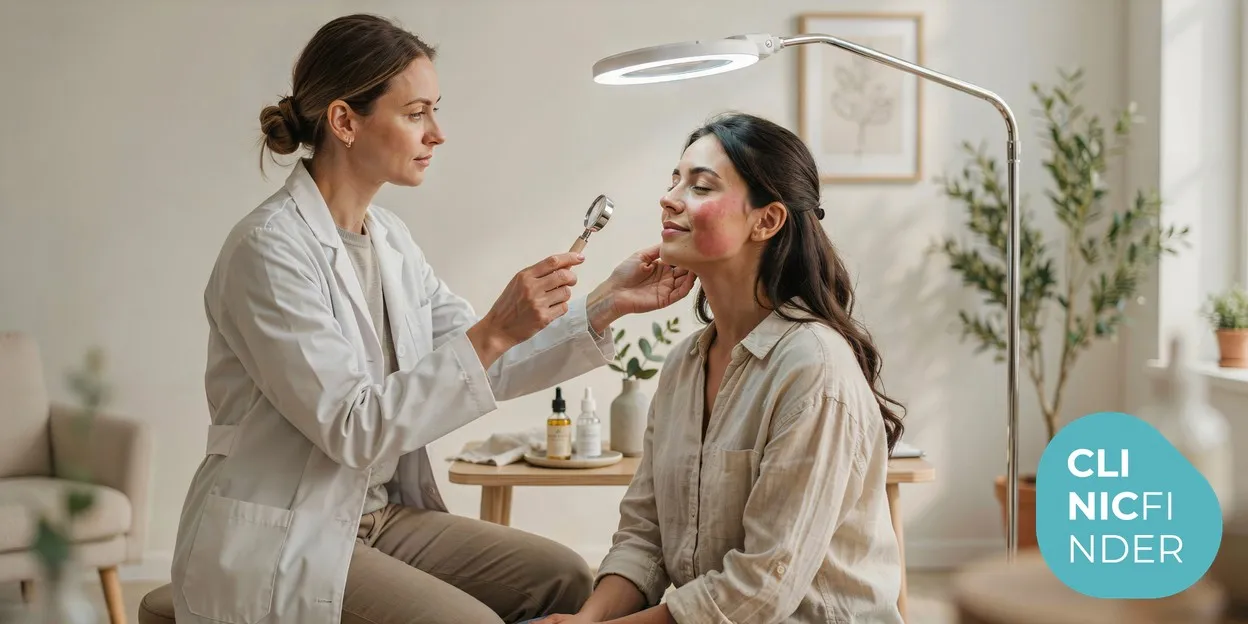
Rosacea is chronic. The honest headline, before anyone sells you a treatment, is that it can be managed but not cured. Triggers vary widely — sun, heat, alcohol, spicy food, hot drinks, stress, temperature swings and harsh skincare are common culprits — and a large part of long-term control is learning and avoiding your own.
Get the diagnosis right first
Facial redness has several possible causes, and not all of them are rosacea — seborrhoeic dermatitis, lupus, sun damage and simple sensitivity can all look similar. That is why it is worth seeing a GP or dermatologist for a diagnosis before you spend money on clinic treatments. Getting the label right means any treatment is aimed at the correct problem.
A GP or dermatologist can also prescribe medical treatments that a beauty clinic cannot. Depending on the type of rosacea, these may include prescription-only topical creams and gels or a course of oral medication for the inflammatory bumps. These are prescription-only medicines, prescribed and monitored by a suitably qualified clinician after assessment — this article is educational and not a recommendation to seek any specific drug. The key point is that medical treatment and clinic-based light treatment often work best together: creams and tablets tend to help the bumps and inflammation, while light and laser target the redness and vessels those medicines barely touch.
Think of it as division of labour: medical treatment calms the inflammation, light-based treatment tackles the colour. Neither cures rosacea, but combined they can make a real difference.
What clinics actually offer for rosacea
For the redness and visible vessels — the features people most want gone — the mainstay clinic treatments are light and laser based. They work on a shared principle: the light energy is absorbed by the haemoglobin in dilated blood vessels, heating and collapsing them so they fade from view, while sparing the surrounding skin.
| Treatment | Best for | Typical course | Good to know |
|---|---|---|---|
| IPL (intense pulsed light) | Diffuse background redness and flushing, plus finer vessels | Often a course of several sessions | Broad-spectrum light; versatile but operator-dependent |
| Vascular lasers (pulsed-dye, KTP, Nd:YAG) | More defined visible vessels and stubborn redness | Often a course of several sessions | More targeted wavelengths; choice depends on vessel depth and skin tone |
| LED light therapy | Calming inflammation as a gentle adjunct | Regular short sessions | Supportive only; not a substitute for the above |
IPL (intense pulsed light)
IPL uses a broad spectrum of light rather than a single laser wavelength, which makes it a flexible tool for the diffuse, blotchy redness and flushing many people with rosacea have. It typically takes a course of several sessions, commonly spaced a few weeks apart, and many people notice their overall complexion looks calmer and more even as the course progresses. Because IPL delivers a lot of light energy across a wide area, the skill of the operator and the settings they choose matter a great deal.
Vascular lasers
When the problem is more clearly defined visible vessels, a targeted vascular laser is often the better fit. Several types are used — pulsed-dye laser, KTP (532nm) and Nd:YAG (1064nm) among them — and a good practitioner chooses based on the size and depth of the vessels and, crucially, your skin tone. These lasers can be very effective at fading individual threaded veins and persistent redness, again over a course rather than in a single visit.
LED and other adjuncts
Some clinics offer LED light therapy as a gentle, calming add-on. The evidence here is softer, and it should be framed as supportive rather than a treatment that will clear vessels on its own. Thickened skin from long-standing rhinophyma is a more specialist matter, sometimes managed with laser resurfacing or minor surgical techniques, and is best assessed by a dermatologist or surgeon rather than a general aesthetic clinic.
What results can you realistically expect?
This is where honest expectations matter. Light and laser treatments can produce a genuine, visible reduction in redness and vessels for many people — often enough to change how confident someone feels going make-up free. But three realities deserve equal billing:
- It is not a cure. Rosacea is chronic. Treatment reduces the appearance; it doesn’t switch off the underlying tendency to flush and form vessels.
- Results are not permanent. New vessels can form and redness can creep back over months to years, so most people need occasional maintenance to hold their result.
- It is a course, not a one-off. Meaningful improvement usually needs several sessions, and outcomes vary from person to person — some respond beautifully, others more modestly. No responsible clinic can guarantee a particular result.
Light treatment also does little for the inflammatory bumps of papulopustular rosacea; those are usually better addressed with medical treatment from a GP or dermatologist. Setting these expectations early is one of the clearest signs of a trustworthy clinic.
Risks and who should be cautious
For most people, side effects are mild and short-lived: redness, warmth, mild swelling and occasionally bruising or temporary darkening that settle within days. More significant problems — burns, blistering or lasting pigment changes — are uncommon but real, and the risk rises with the wrong device settings, treatment on a recent tan or darker skin tone without appropriate adjustments, or an inexperienced operator. Heat is itself a rosacea trigger, so a temporary flush after treatment is normal.
Extra caution, and often a firm “not right now”, applies if you:
- Have a recent suntan or fake tan, or have had significant sun exposure
- Take photosensitising medication or have a light-sensitive condition
- Are pregnant or breastfeeding (many clinics defer treatment)
- Have an active skin infection or open sores in the area
- Have a deeper skin tone — some devices and settings carry more risk of pigment change, so an experienced practitioner and appropriate device are essential
A proper consultation, an honest discussion of your skin type and a patch test before a full session are the marks of a clinic taking your safety seriously.
Managing rosacea day to day
Whatever clinic treatment you choose, it works better alongside good everyday care, and this is where much of your long-term control actually lives:
- Wear a broad-spectrum SPF every day — sun is one of the most common triggers
- Use gentle, fragrance-free cleansers and moisturisers; avoid harsh scrubs, alcohol-heavy toners and strong actives unless advised
- Learn and avoid your own triggers — a simple diary can reveal them
- Be sceptical of anything promising to “cure” rosacea overnight
Choosing a clinic wisely
Rosacea treatment is a good example of why the clinic matters more than the marketing. The same IPL or laser can deliver a lovely result in expert hands and a burn in careless ones. Before you book, look for a clinic that insists on a proper assessment, is comfortable working with your skin tone, offers a patch test, is candid that rosacea is managed rather than cured, and is happy to work alongside your GP or dermatologist. If they lead with guarantees or a headline discount rather than a conversation about your skin, treat that as a warning sign.
It is also worth understanding the technology before you commit. Our guide to IPL versus laser explains the difference between these two approaches in plain terms, LED light therapy covers where gentler light fits in, and if pigmentation is part of your picture, hyperpigmentation treatments is a useful companion read.
Above all, choose your practitioner as carefully as your treatment. Use Clinic Finder to compare accredited clinics near you, check that your practitioner is properly trained on medical-grade vascular devices, and ask directly about their experience with rosacea, the device they would use for your skin tone, and how they manage flares and maintenance. The right clinic will welcome those questions.
